









Exporting lithium batteries from China in 2026: UN 38.3, dangerous-goods packaging and the new air rules
Cells, battery packs, storage systems and equipment with batteries all ship as Class 9 dangerous goods. The UN numbers, the UN 38.3 test summary, the customs packaging appraisal that Chinese exporters need before clearance, the labels — and the 2026 air rule that limits batteries packed with equipment to 30% state of charge.

- 01Lithium batteries are Class 9 dangerous goods; the UN number depends on chemistry and on whether the battery ships alone, packed with equipment or contained in equipment.
- 02Every cell and battery type needs a passed UN 38.3 test and a test summary before it ships, unless an exception applies.
- 03Chinese exporters of UN 3480, 3481, 3090 and 3091 need a customs use appraisal of their dangerous-goods packaging; packaging without it may not be exported.
- 04From 1 January 2026, lithium-ion batteries packed with equipment go by air at no more than 30% state of charge (cells and batteries above 2.7 Wh); batteries shipped alone already had this limit.
- 05Sodium-ion batteries with organic electrolyte now ship under their own entries, UN 3551 and UN 3552.
Start with the classification
Lithium batteries are Class 9 dangerous goods in every transport mode. The UN number depends on chemistry and packaging:
| UN number | What it covers |
|---|---|
| UN 3480 | Lithium-ion batteries shipped on their own (including power banks) |
| UN 3481 | Lithium-ion batteries packed with or contained in equipment |
| UN 3090 / UN 3091 | Lithium metal batteries, alone / with or in equipment |
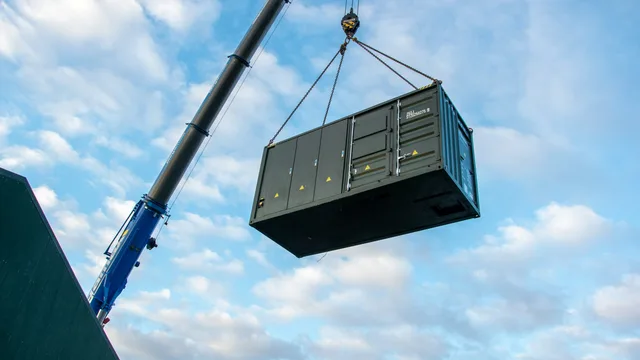
| UN 3536 | Lithium batteries installed in a cargo transport unit, such as a containerised storage system |
| UN 3551 / UN 3552 | Sodium-ion batteries with organic electrolyte, alone / with or in equipment |
Semi-solid and other new lithium chemistries are still lithium-ion batteries for transport. Sodium-ion batteries with an aqueous alkaline electrolyte ship as UN 2795.
UN 38.3: the test summary
Before shipment, each cell and battery type must have passed the tests of the UN Manual of Tests and Criteria, section 38.3: altitude, thermal, vibration, shock, external short circuit, impact or crush, overcharge and forced discharge. The manufacturer — and later distributors — must make a test summary in the format of 38.3.5 available. Airlines, shipping lines, forwarders and customers ask for it first.
Check three things on the summary: the model and Wh rating match the product and the shipping documents, the revision of the Manual is stated, and the battery test refers to a cell type that has its own passed test.
China Customs: the packaging appraisal
Under article 17 of the Law on Import and Export Commodity Inspection and article 29 of its implementing regulations, packaging used for dangerous goods exports must be appraised; goods in packaging that has not been appraised, or failed, may not be exported. For lithium batteries this works in two steps:
- Performance inspection — the packaging manufacturer has its UN packaging tested and receives a performance inspection result sheet.
- Use appraisal — the battery exporter applies through the China International Trade Single Window ("outbound packaging", category "dangerous goods packaging use") at its local customs office and receives the use appraisal result sheet.
Customs lists these documents for the use appraisal:
- the packaging inspection application form;
- the packaging performance inspection result sheet;
- the factory inspection record or a declaration of product conformity;
- the hazard classification report for the dangerous goods;
- a copy of the sales contract.
The appraisal applies to UN 3090, 3091, 3480 and 3481. UN 3171 (battery-powered vehicles) and UN 3536 do not need it, but still have to meet the rules of the transport mode. Batteries that meet special provision 188 can ship without the appraisal if they carry the lithium battery mark.
In the customs declaration, give the UN number, hazard class, packing group and UN packaging mark, and upload the use appraisal result sheet.
Labels and markings
- Class 9A lithium battery hazard label on the package; the Class 9 label when placed on the outside of a transport unit.
- The rated capacity in Wh on the outside of every lithium-ion battery.
- The lithium battery mark for shipments under special provision 188.
Customs cases show what goes wrong: shipments declared as non-dangerous and later found to be dangerous goods (fined), battery packs without a Wh marking (ordered to correct), battery packs that could switch on in transit, and cells shipped by air above 30% state of charge.
Air: the 2026 state-of-charge rules
The IATA guidance for 2026 summarises the rules adopted by ICAO:
- Batteries on their own (PI 965): lithium-ion cells and batteries must ship at no more than 30% of rated capacity; higher only with approval of the State of Origin and the State of the Operator (special provision A331). They may not go on passenger aircraft unless approved under A201.
- Packed with equipment (PI 966), new from 1 January 2026: the 30% limit now applies here too — to all cells and batteries under Section I, and to those above 2.7 Wh under Section II. Above 30% only with State approval.
- Contained in equipment (PI 967): 30% state of charge, or an indicated battery capacity of 25%, is strongly recommended but not mandatory.
- Sodium-ion (PI 976–978): UN 3551 and UN 3552 have their own packing instructions; no state-of-charge limit has yet been set for sodium-ion batteries packed with or contained in equipment.
Rated capacity is determined as described in sub-section 38.3.2.3 of the UN Manual. Set the shipping state of charge at the end of the production line, and record it.
Sea and road
Sea freight follows the IMDG Code and road transport in Europe follows ADR. Large storage systems often ship as UN 3536 in their container, or as UN 3480 battery modules with the enclosure shipped separately. Ask the shipping line early: many carriers set their own conditions for lithium batteries on top of the code.
A checklist before the first shipment
- UN 38.3 test summary for every cell and battery type, matching the product label.
- Safety data sheet and, where the forwarder asks for it, a transport classification report.
- Packaging performance inspection by the packaging supplier, then the customs use appraisal.
- Labels, Wh marking and the declared UN number consistent across product, carton and declaration.
- State of charge set and recorded for air shipments.
- Protection against short circuit and accidental activation in the package.
UN 38.3 is planned best together with the product certification the battery needs anyway — IEC 62619, UL 1973 or GB 44240 for storage, GB 31241 and GB 47372 for power banks — so that one set of samples and one product definition carry through to the shipping documents.
FAQ
Is a UN 38.3 report a certificate?
No. UN 38.3 is a set of transport tests. The proof is a test report and a test summary in the 38.3.5 format; carriers and customers check the summary. It is not an administrative licence.
Do I need a customs packaging appraisal for a containerised storage system?
Systems shipped as UN 3536 (lithium batteries installed in a cargo transport unit) do not need the use appraisal under the customs interpretation, but they must meet the sea or road rules for UN 3536. Battery modules shipped separately as UN 3480 do need it.
What changed for air shipments in 2026?
From 1 January 2026, lithium-ion batteries packed with equipment (PI 966) must ship at no more than 30% state of charge — under Section II for cells and batteries above 2.7 Wh. Batteries shipped alone already had this limit; for batteries contained in equipment it remains a recommendation.