GB/T 18487.2-2026: the new EMC standard for EV chargers takes effect on 1 November
China’s EMC standard for off-board charging equipment is replaced after nine years. A new safety floor in immunity tests, RCD checks, fixed test loads and a wider radiated range.
- 01GB/T 18487.2-2026 was published on 30 April 2026 and takes effect on 1 November 2026.
- 02It fully replaces GB/T 18487.2-2017 for off-board EV supply equipment.
- 03Reported changes: no fire, burst or enclosure damage allowed in any EMC test, whatever the functional result.
- 04Residual current device behaviour is now checked as part of EMC testing.
- 05Emission tests run at 20% and 80% of rated power; immunity tests in standby and at 20%.
The facts
| Item | Detail |
|---|---|
| Standard | GB/T 18487.2-2026, EV conductive charging system — Part 2: EMC requirements for off-board EV supply equipment |
| Published | 30 April 2026 |
| In force | 1 November 2026 |
| Replaces | GB/T 18487.2-2017, in full |
| Status | Recommended national standard (GB/T) |
| Committee | China Electricity Council |
The standard is recommended, not mandatory, in its own right. Industry analyses point out that it becomes binding in practice because the mandatory safety standard GB 39752-2024 calls up GB/T 18487.2 for EMC, and CCC certification of EV supply equipment has been compulsory since 1 August 2026. Several write-ups describe the new edition as “mandatory”; strictly, the obligation comes through that chain.
What changes
The official platform confirms the dates and the replacement. The technical changes below come from a published clause-by-clause interpretation, which counts 17 main changes. Check them against the standard text before planning tests.
- A safety floor in every test (clause 7.1). During and after any EMC test, the equipment must not catch fire, burst or suffer enclosure breakage. A test fails on these grounds even if the function recovers.
- Residual current devices (clause 7.1). RCD behaviour is checked as part of EMC testing, including leakage during disturbance tests.
- Fixed operating conditions. Emission tests at 20% and 80% of rated maximum power, with voltage limits covered for constant-power designs; immunity tests in standby and at 20% of rated power. Cabling and port termination are also specified.
- Some tests removed. Selected requirements on input ports, such as voltage dips and short interruptions on DC input ports, are dropped.
- Wider radiated emission range (8.3.5.2) above the previous upper limit, and an updated method for keyless-entry interference (Annex D).
- Harmonic current test voltage (8.2.2) requirements changed.
What manufacturers should do now
- Re-test at the new load points. Low-power operation at 20% is where radiated emissions often peak; design margins found at full load may not hold.
- Treat EMC as a safety test. Component choice, enclosure material and protection circuits need to survive surge and burst without damage, not just recover.
- Prove the RCD under disturbance. Leakage detection must keep working while the charger is being disturbed.
- Check certificate updates. Ask the certification body how existing CCC certificates move to the 2026 edition.
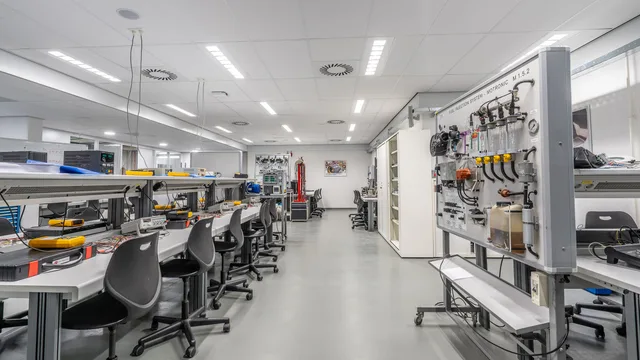
Our partner laboratory network tests DC chargers with 3.75 MW of power supply and a 10 m EMC chamber rated for 2.5 MW AC/DC.
FAQ
When does GB/T 18487.2-2026 apply?
From 1 November 2026. It was published on 30 April 2026 and replaces the 2017 edition in full.
Is it mandatory?
The standard itself is a recommended GB/T. It is binding in practice because GB 39752-2024 refers to it for EMC and CCC certification of EV supply equipment is compulsory.
What is the biggest change?
According to published analyses, a safety floor: no fire, burst or enclosure damage in any EMC test, even if the function recovers.
Sources
 CertificationChina CQC & CCC