









AI data centres are becoming a storage market: what it means for UPS and BESS makers
AI training loads swing in milliseconds, grids are asking data centres to ride through faults instead of dropping off, and storage demand linked to AI could reach 300 GWh by 2030. Why medium-voltage UPS with battery storage is spreading, and what it changes for testing.
- 01Fastmarkets estimates that energy storage demand linked to AI data centres could reach 300 GWh by 2030.
- 02Medium-voltage UPS — a battery storage system with grid-interactive controls between the grid and the data centre — is spreading because it frees floor space and rides through grid disturbances.
- 03In July 2024, about 1 500 MW of data-centre load in Virginia dropped off at once after a transmission fault; a July 2026 event was reported at 3–4 GW.
- 04NERC issued a Level 3 alert on large computational loads on 4 May 2026, asking the industry to act.
- 05LFP dominates the cells: Fastmarkets assessed 314 Ah prismatic LFP cells at 0.35–0.40 yuan/Wh in June 2026.
A new kind of load
AI data centres are not just large; they behave differently. Training clusters switch thousands of accelerators on and off almost simultaneously, so power draw can swing sharply within moments. At gigawatt scale, that becomes a grid problem — and the classic answer, a UPS in the data hall, was not designed for it.
Fastmarkets estimates that energy storage demand directly linked to AI data centres could reach 300 GWh by 2030. US power consumption is projected to grow 5 % in 2026, and data centres could account for up to 12 % of US electricity use by 2028.
When data centres drop off the grid
Grid operators have a specific worry. In July 2024, a fault on a 230 kV line in Virginia triggered the simultaneous loss of about 1 500 MW of data-centre load. NERC’s review found that the load was lost at 60 points across 25 substations — not tripped by the utility but by the data centres’ own protection, which switched to backup power and stayed there until manually reconnected.
The problem has grown. A July 2026 event in Virginia was reported at 3 to 4 GW. On 4 May 2026 NERC issued a Level 3 alert — its highest level — on large computational loads, with responses due in August 2026. The direction is clear: large loads will be expected to ride through grid disturbances, much as power plants must.
Why medium-voltage UPS is spreading
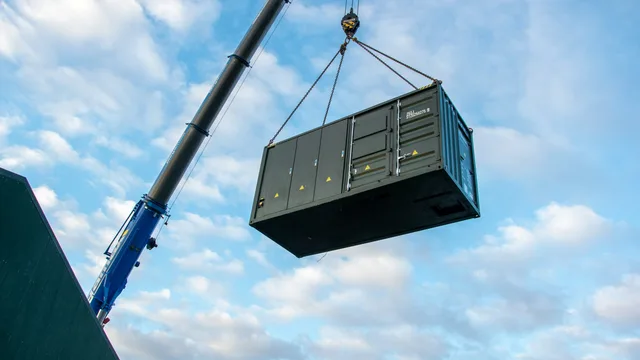
A traditional UPS sits inside the data hall at low voltage. A medium-voltage UPS sits outside, between the grid and the facility, and combines a battery energy storage system with grid-interactive controls. Developers cite three advantages:
- Ride-through. It stays online through voltage dips and spikes and keeps the load supplied, instead of disconnecting.
- Power quality. It absorbs the rapid load swings of AI training before they reach the grid.
- Space. Removing low-voltage UPS equipment and heavy copper from the building frees floor space for computing.
The battery side is shifting too. Lead-acid is losing ground in dense AI facilities, and LFP dominates new installations; Fastmarkets assessed 314 Ah prismatic LFP cells at 0.35–0.40 yuan/Wh in June 2026.
What it changes for testing
The equipment in these projects sits between two worlds — data-centre power and grid-scale storage — and has to satisfy both:
| Question | Typical evidence |
|---|---|
| Does the UPS function meet the specification? | IEC 62040-3 performance and classification; efficiency at partial load |
| Is the UPS and power conversion safe? | IEC 62040-1; IEC 62477-1 for the power converter |
| Is the battery system safe? | UL 9540 and UL 9540A in North America; IEC 62619 for cells and modules |
| Does it ride through grid disturbances? | Voltage and frequency ride-through tests at the converter, against the utility’s interconnection rules |
| Does it disturb other equipment? | EMC of high-power converters, including harmonics |
Two points stand out. First, ride-through has to be tested as behaviour, not declared: dips of different depths and durations, recovery and repeated events. Second, efficiency matters at the operating points the system actually sees — a UPS that spends most of its life at partial load should be measured there.
TSINGHU tests UPS systems to the IEC 62040 series and storage converters up to 2.5 MW in China — performance, safety, grid behaviour and EMC — so equipment for AI data-centre projects can be verified before it goes into a tender.
FAQ
Is a medium-voltage UPS the same as a grid-scale battery?
It uses the same battery storage technology but serves a different purpose: it sits between the grid and one data centre, keeps the load supplied through disturbances and smooths fast load swings. Grid-scale batteries serve the network as a whole.
Why are grid operators concerned about data centres?
Because large data centres can disconnect all at once during a grid fault. In 2024 about 1 500 MW of data-centre load in Virginia dropped off simultaneously; NERC issued a Level 3 alert on large computational loads in May 2026.
Which tests matter most for UPS and storage in AI projects?
Performance and efficiency to IEC 62040-3, safety to IEC 62040-1 and IEC 62477-1, battery system safety (UL 9540/9540A or IEC 62619) and ride-through behaviour against the local interconnection rules.
Sources
- Fastmarkets (28 Jul 2026): medium-voltage UPS at AI data centers a growing source of BESS LFP cell demand
- NERC: Incident Review — Considering Simultaneous Voltage-Sensitive Load Reductions (large load loss, Virginia 2024)
- Renewable Energy World: NERC issues Level 3 alert on data centre loads
- APPA: PJM and Dominion review a large data centre load transfer event (July 2026)
- DCD: why UPS battery technology needs to evolve for AI data centres